Led the design and research of Verizon Cloud - Refer a Friend feature, simplifying the RAF process, making it more findable, and usable. It improved engagement and drove referrals, resulting in a 9.8% increase in successful referrals, a 12% boost in user retention, and a 36.2% drop in referral abandonment rates.

My Role: Lead Product Designer (Research, Design, Testing, and Implementation)
Cross-functional Collaborations: Researcher, Content Strategist, Data Analyst, Product Owner, SMEs, Customer Experience Manager, Stakeholder Rep, QA, and Engineers
Overview
Currently, Offer Portal SMS campaigns - allows us to send messages to Verizon Wireless customers, prompting them to buy/upgrade cloud; the link in that message contains a link to the offer portal, which has the receiver's MDN embedded; so when they click it, the offer portal can check their MDN and verify they are already a VZW customer, and therefore skip all prompts to log in and present them with a list of plans to buy. The RAF feature is not visible to these customers and is not being leveraged to benefit them or Verizon's business.
The problem
• Low click-through rates of 3-5%
• High opt-out rates of about 20%
• Technical issues, such as broken links
• Lack of Personalization - Non-tailored messages lead to an 18% lower response rate, as users feel disconnected from the offer.
"How might we design a RAF feature that leverages current cloud members, provides incentives to invited friends, increases visibility, enhances user engagement, and drives referrals?"
Constraints
Replicating the Offer Portal experience is impossible for RAF because we can only embed the referee MDN in an offer portal link if the referrer can provide that MDN when generating a referral; but the business does not want referrers to have to look up MDNs in advance; they want us to provide a link, which the referrer can then put in an SMS (a native feature of their mobile device, which we have no visibility of), and thus send to at least one (but preferably many) people in their address book.
Business Goal
• Develop a RAF feature that enables Verizon Cloud members to invite Verizon customers who do not have a cloud subscription.
• Increase referrals in comparison to current stats and enhance usability.
• Currently, we are missing a chance to increase our member database and ultimately generate more business.
Project Kickoff & Requirement Gathering
Project Kickoff & Requirement Gathering
The Refer a Friend feature aims to drive user acquisition by enabling existing users to invite their network in exchange for rewards. This initiative will focus on creating a seamless referral flow, clear incentive structures, and tracking mechanisms. Key deliverables include a user-friendly referral interface, integration with reward systems, and analytics for performance tracking. We will prioritize ease of use, transparency, and alignment with user engagement goals.
The team discussed the available metrics around referrals to determine why a large portion of users who visited the referral landing page did not share their unique referral links. We aligned with the business and technical team on timeline, constraints, objectives, and workflow with the scrum team.
Persona
Current Verizon Wireless customers | Referee: VZ Customer with Premium Cloud Account | The Referred: VZ Customer without Premium Cloud Account | iOS & Android
How it works.
• A Verizon Premium Cloud member is eligible to invite 10 Verizon customers with no Premium Cloud Account by sending a unique referral link.
• When a friend that's referred begins a paid subscription after a free trial period, the referee gets $10 off their bill for a month
• Referee is eligible to send 10 referrals for a year totaling $100 in credits
Constraints
1. Work with the Cloud team to understand the solution for Offer Portal SMS campaigns (See what's transferrable flow/journey/design wise)
2. Provide a solution that's feasible for the 11/21 release
Upon the first launch, we will work with the analytics team using these metrics to measure success.
1. How many referrals a user has sent
2. how many of those got redeemed and by whom
3. Which of the "redeemed" still have cloud 30 days later
4. Which of the "redeemed" still have cloud 60 days later
Researching the Problem via Survey
Researching the Problem via Survey
In addition to the data already collected, I collaborated with the research team, and we conducted users survey by sending emails to premium members.
• Sent out email debriefing incentives of RAF to premium members
• Survey ran for about 3 weeks
Survey Questions
Understanding Refer a Friend Usage Among Verizon Premium Members
Are you aware of Verizon's Refer a Friend program?
- Yes / No
- Ease of Use
Have you tried using the Refer a Friend feature?
- Yes / No
- If no, why?
- Didn’t know how to use it
- Too complicated
- Never needed to refer anyone
- Incentives
Do you feel the referral rewards are appealing?
- Yes / No
What would make the rewards more attractive?
- Higher monetary rewards
- Additional services or discounts
- Other: [open-ended]
- Motivation
What’s your main reason for not referring friends?
- I don’t know anyone who would be interested
- No personal benefit
- Don’t feel comfortable referring
- Other: [open-ended]
Survey Findings
Awareness Gap
40% of respondents were unaware of the Refer a Friend program.
Ease of Use:
Among those aware, 25% cited difficulty understanding or using the feature.
Incentives
About 30% felt the rewards were not compelling enough, with most preferring higher monetary benefits.
Motivation Barriers
Some mentioned not knowing eligible friends, and 20% felt the rewards didn’t justify the effort.
Recommendations from participants
• Enhance program visibility through targeted communications
• Simplify the referral process with step-by-step guidance
• Reevaluate reward structures to align with customer preferences
• Provide alternative incentives, like exclusive perks or service upgrades
User Flow
Guiding users through inviting friends and redeeming rewards.
Key steps include:
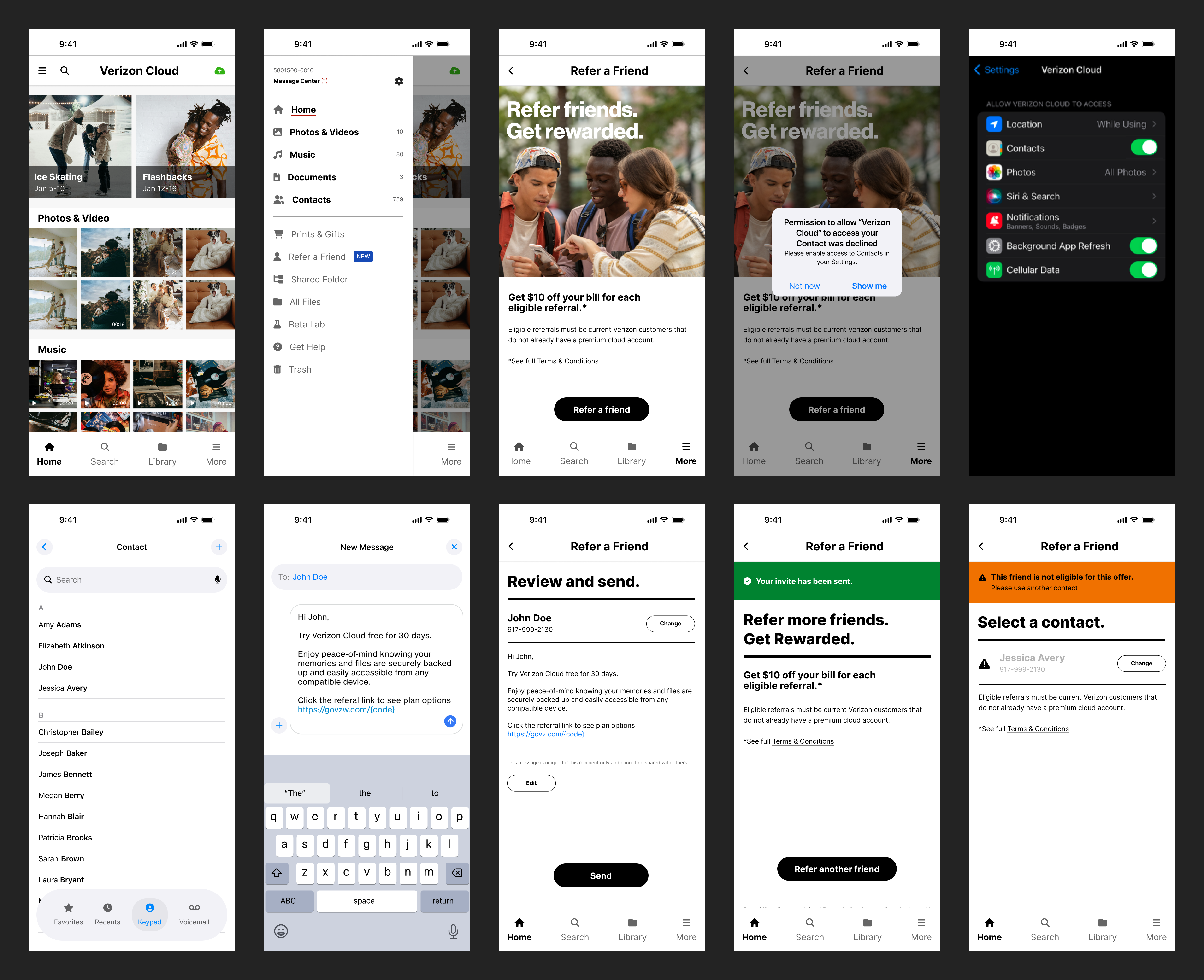
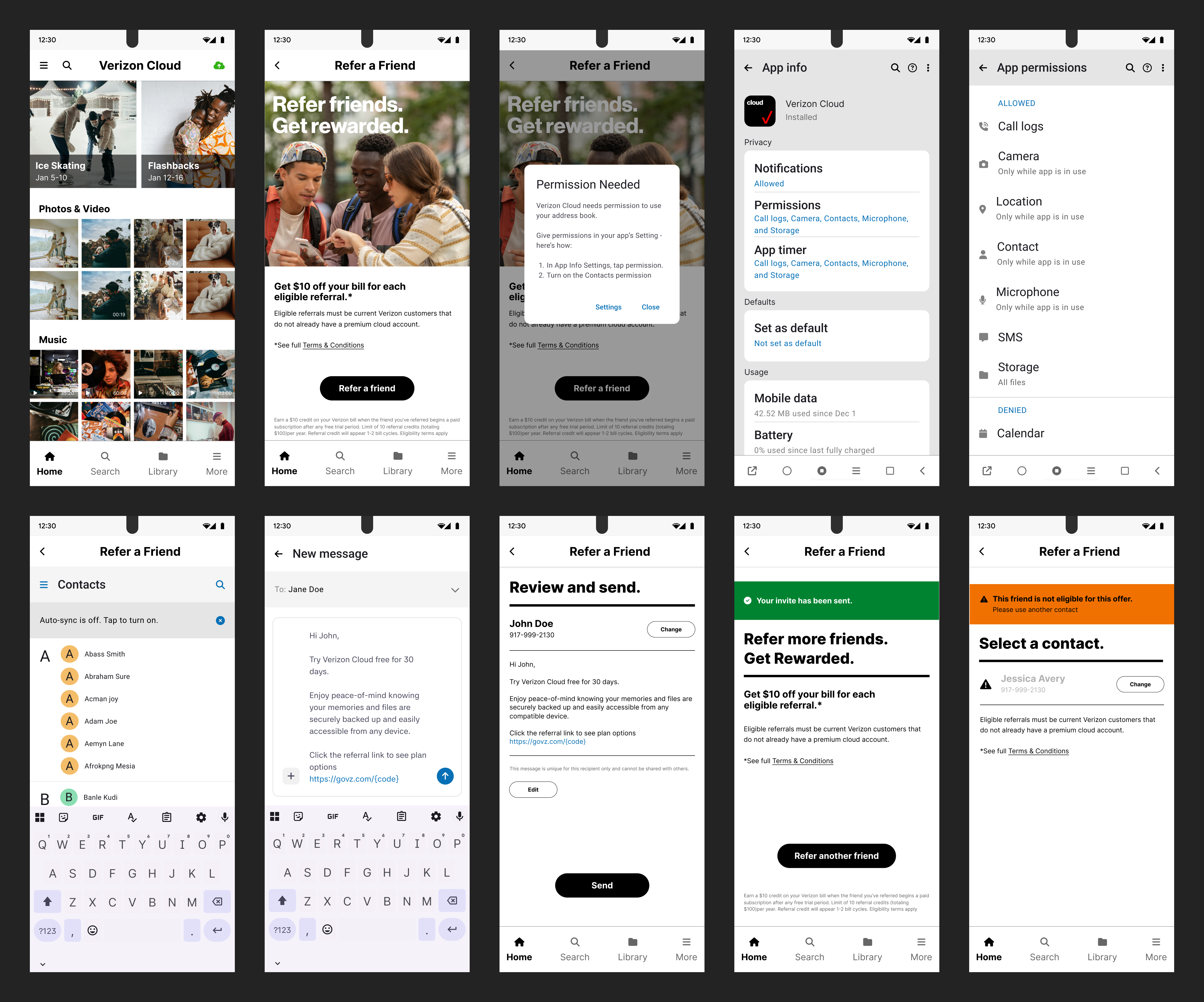
Access the Feature: Users find the RAF option in the app's rewards section.
Generate Referral Link: Users create a unique referral link or code.
Share with Friends: Users share the link via email or SMS.
Track Referrals: Users monitor referral status (e.g., pending, successful) in a dashboard.
Redeem Rewards: Once friends join and meet the criteria, users receive and redeem rewards.
I worked cross-functionally with the scrum team to create a design that solves the usage problem. I leveraged reusable native iOS and Android UI components, ensured seamless backend integration, and implemented referral tracking with real-time updates.

Wireframe & LoFi | Phase 1
Having gathered and synthesized data from the kickoff and research, I created low-fidelity wireframes to establish layout and navigation, focusing on key screens like referral entry and sharing options. Feedback was gathered from stakeholders and the scrum team, followed by refinements to add detail and address usability concerns.

Refer a Friend Process | iOS
Refer a Friend Process | iOS
After a series of demos, feedback, iterations, and approval of the LoFi mockup, I began leveraging the VZ Design System + A11Y Resources + native iOS & Android components to create HiFi mockups and interactive prototypes.
Refer a Friend Process | Android
Refer a Friend Process | Android
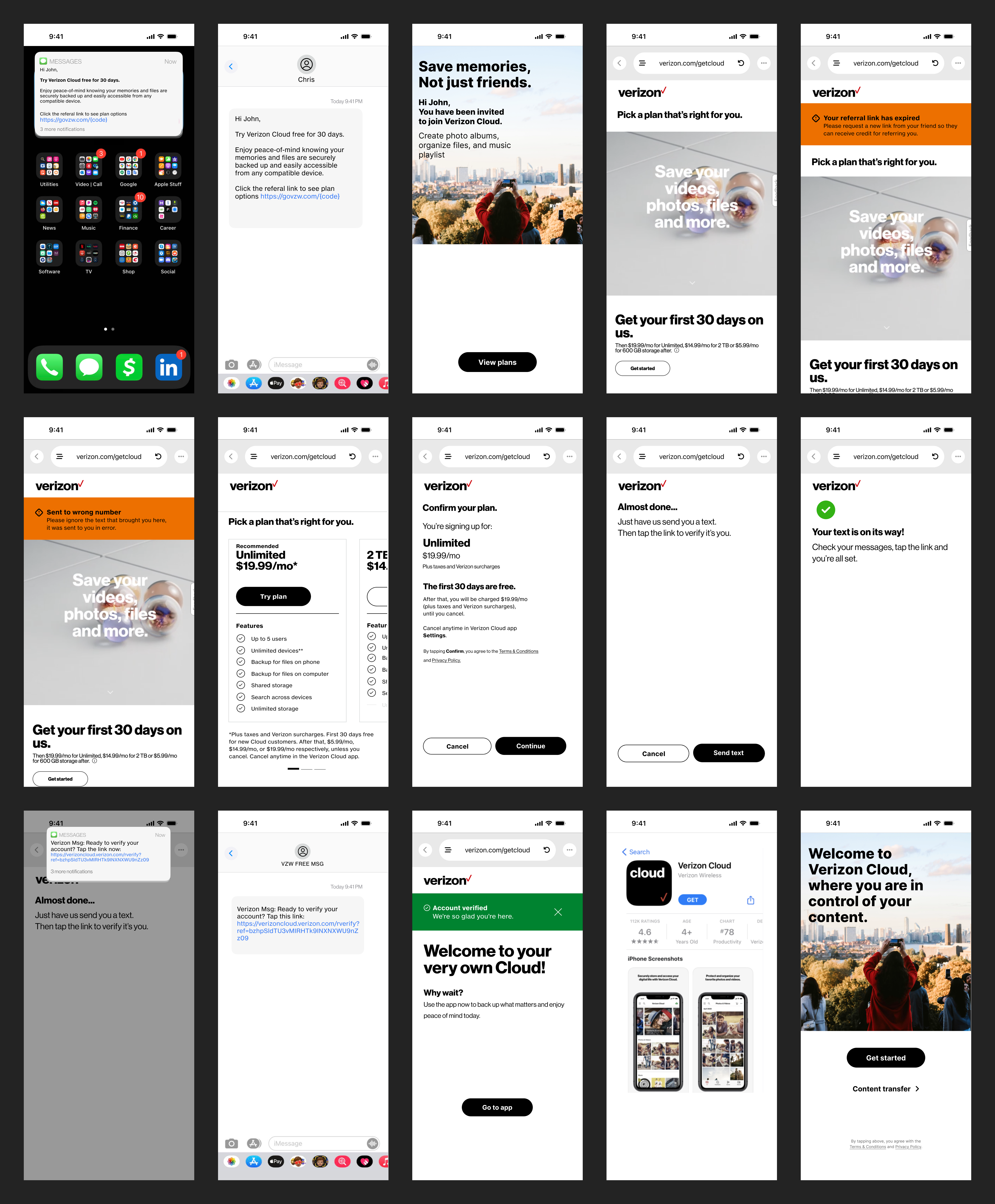
The Referree Receives a RAF Notification | iOS
The Referree Receives a RAF Notification | iOS
The Referree Receives a RAF Notification | iOS
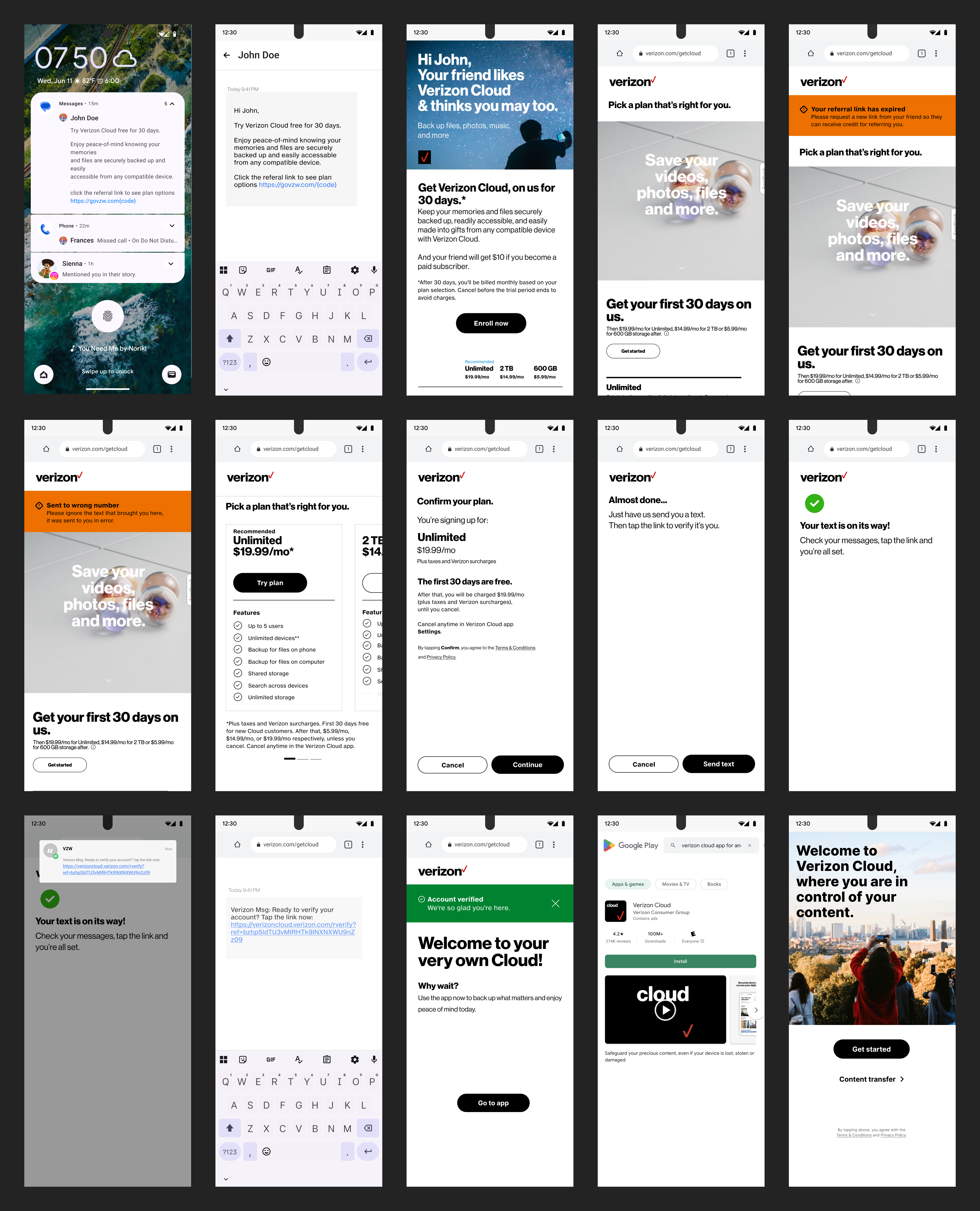
The Referree Receives a RAF Notification | Android
The Referree Receives a RAF Notification | Android
The Referree Receives a RAF Notification | Android
Testing what's designed thus far
Testing what's designed thus far
We put some testing plans in motion on UserZoom. The primary goal is to evaluate the user experience and effectiveness of the "Refer a Friend" feature prototype. We want to understand how easily users can refer a friend, how intuitive the UI is, and to identify potential pain points in the referral process.
Research Questions
Can users easily find the "Refer a Friend" option within the app/site?
Do users understand how to use the feature without additional guidance?
How easy is it for users to refer a friend?
Are there any barriers or frustrations in the referral process?
Do users feel confident that their referral was successfully sent?
How satisfied are users with the overall process and design?
Findings / User Feedback
Is there a limit to the number of referrals I can send in a specific timeframe?
Where do I keep track of those that'd redeemed my refer link, do I get an email or some sort of notification each time?
How do I use the points I get from referring someone?
I may be more motivated to send out these referrals if the incentive is more attractive.
The feature is a bit buried, and I had to dig for it.
Target Audience
Demographics: Active users of the app or website, aged 18-45, tech-savvy, and familiar with referral programs.
Behavioral criteria: Users who have not yet used the referral feature, but are regular users of similar services.
Methodology
Task-Based Usability Testing: Observing users as they interact with the "Refer a Friend" feature prototype.
Moderated Sessions: Conducting remote testing through UserZoom with a facilitator guiding participants.
Platform: UserZoom’s usability testing platform (prototype link shared via email).
Recording: Screen recording, voice recording, and task completion status.
Metrics Collected: Time to complete task, success rate, error rate, and subjective satisfaction ratings.
Testing Success Rate
Task Completion Rate: ≥85% of participants complete the tasks successfully without guidance.
Usability Satisfaction: ≥80% of participants rate their experience positively (via open-ended feedback).
Task
Find the Referral Feature Find the "Refer a Friend" button or link in the app menu.
Success criteria: Participants should easily locate the referral feature without guidance.
Referral Process:
a) Referral via menu:
Success criteria: Participants can complete the referral process with minimal assistance, fill out the required fields, and send the referral.
b) If a friend is not eligible, select another friend from your contact list
Success criteria: The user can change to a different contact and is confident in how to do it.
Post-Referral Feedback
Confirm that your referral was successfully sent and that you understand the next steps (reward tracking, referral status, etc.). Success criteria: The user feels confident that the referral was completed and understands the reward system.
Tasks Flow Introduction (5 min):
Briefing participants on the test objectives. Main Tasks (10-20 min): Participants will complete the 3 primary tasks outlined above.
Debrief (5-10 min):
Ask follow-up questions about user experience, satisfaction, and any suggestions for improvement.
Iterative Design Process | Phase 2
Iterative Design Process
Leveraging the feedback from our prototype usability testing to enhance the design.
Key areas:
1. More incentives: increase from $10 per invitee to $20 = $200/yr (connect with the business to discuss if there's a possibility to increase this as a result of the initial survey)
2. Begin feature to the referral tracking process
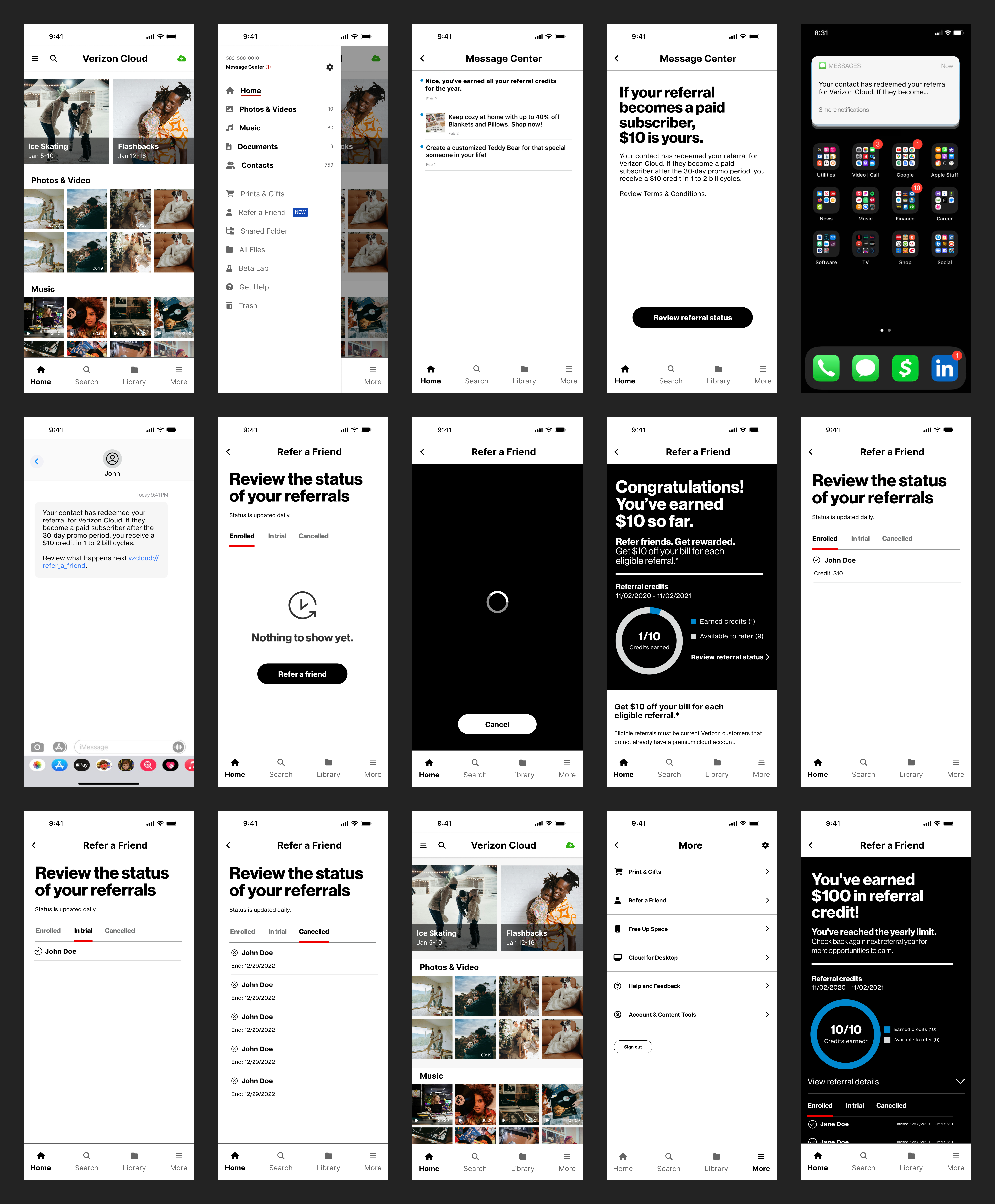
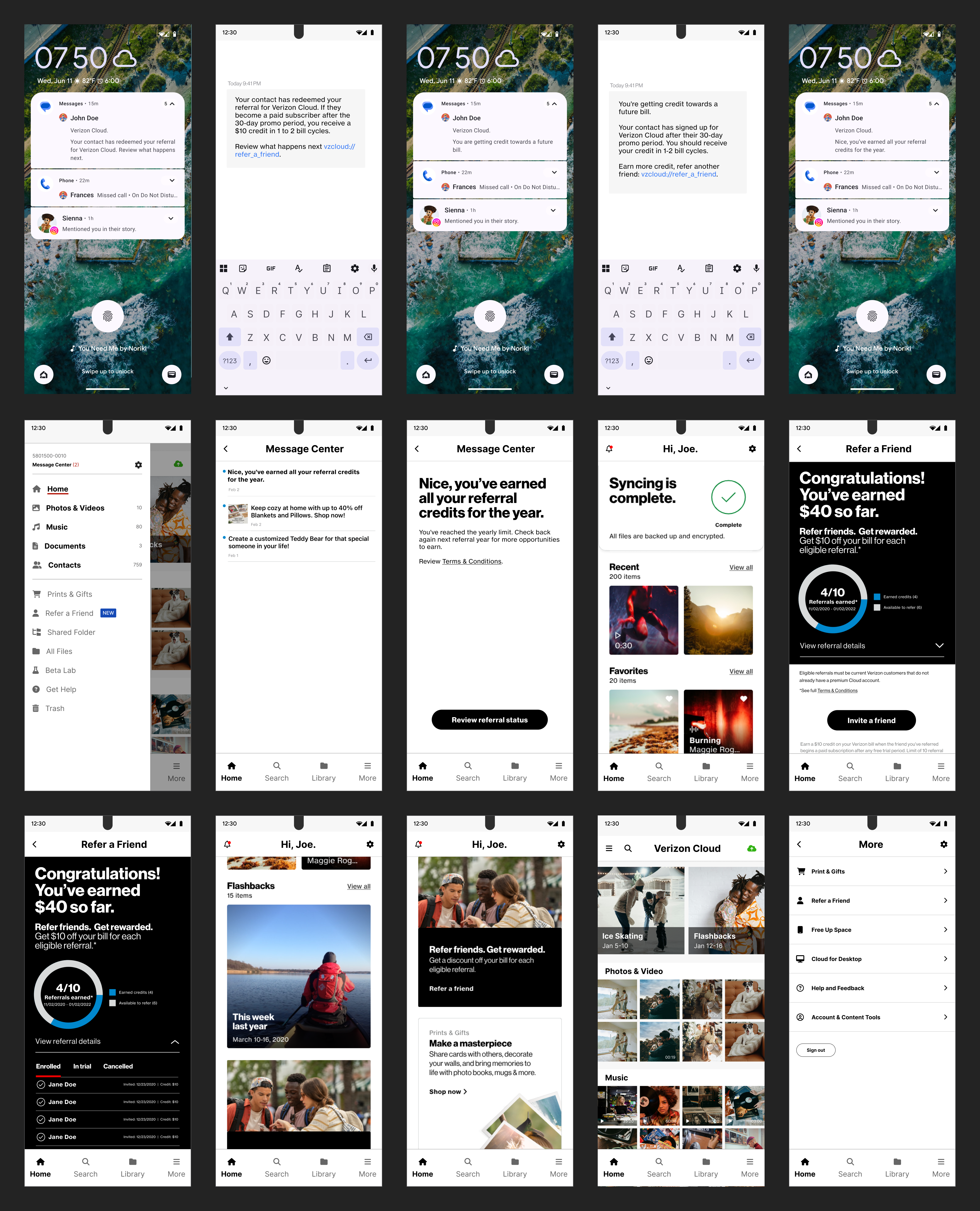
3. Design for other entry points (email, message center, and push notifications)
Wireframe & LoFi

Referrer Receives a Notification | iOS
Referrer Receives a Notification | iOS
Referrer Receives a Notification | Android
Referrer Receives a Notification | Android
Increased Incentives
Increased Incentives
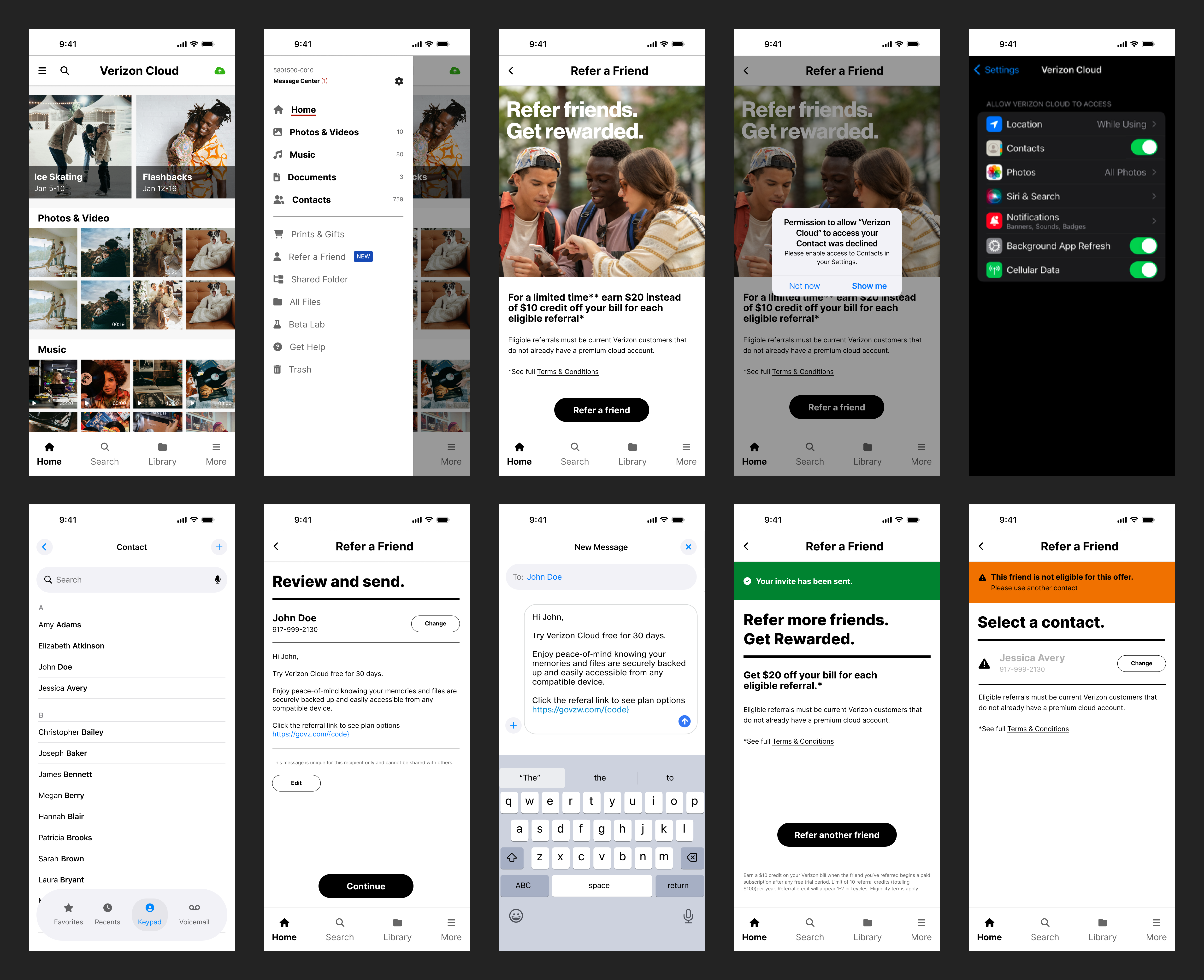
A decision was made by the business to increase the incentive to $20 per referral for a limited time, totaling $200 for 10 eligible referrals a year. This is due to our findings that a high percentage of users say they may be inspired to refer members to the cloud services if the incentives are attractive enough to use towards their bill.
Conclusion | Challenges & Metrics
The Refer a Friend experience was delivered through close collaboration across Product, Design, Engineering, and key stakeholders. We structured the work across multiple PI's, allowing engineering to begin implementation while design continued to validate and refine upcoming use cases.
Stakeholder dependencies occasionally affected our initial timeline. To maintain momentum, the team prioritized ready-to-build backlog items and moved lower-priority or exploratory concepts into a post-MVP roadmap. This helped us protect the core experience while staying focused on the business goal: making referrals easier to discover, understand, and complete.
Impact
Following the initial launch, we saw measurable improvements within a month across key referral behaviors:
+9.8% increase in successful referrals sent across the premium account members
+12% improvement in retention among users engaging with the referral experience
36.2% reduction in referral-flow abandonment
13.% increase in referees who redeemed and still have Cloud 30 days later
These results suggested that improving feature discoverability, simplifying the referral journey, and providing clearer progress and incentives helped more users move from referral awareness to successful completion.
Future Opportunities
The MVP established a strong foundation, while also revealing opportunities to continue improving the experience. Future iterations could explore more personalized referral prompts, stronger reward visibility, contextual entry points across Verizon Cloud, and experimentation with messaging and incentives to further increase referral conversion and repeat engagement.
Case Study Note
Due to confidentiality and the unavailability of the original production Figma files, portions of this case study were recreated to accurately communicate the design process and experience. Some low-resolution assets were also reconstructed for presentation quality.
Select photography is sourced from Pexels for illustrative purposes only and does not represent licensed imagery used in the production of the Verizon experience.

ComplianceWireEnterprise training platform redesigned to mitigate risks

XTM - DocXtractA solution for extraction efficiency

Verizon | Refer a FriendCloud feature to increase user retention
Sendyfast - Mobile AppUX Design

T.Rowe Price - Subscription SearchUI/UX Design

Qunol - Website RedesignDigital, Web & UX

Qunol - Amazon StoreDigital, Brand & UX

Instant Drink Mix | Product AwarenessProduct Awareness